
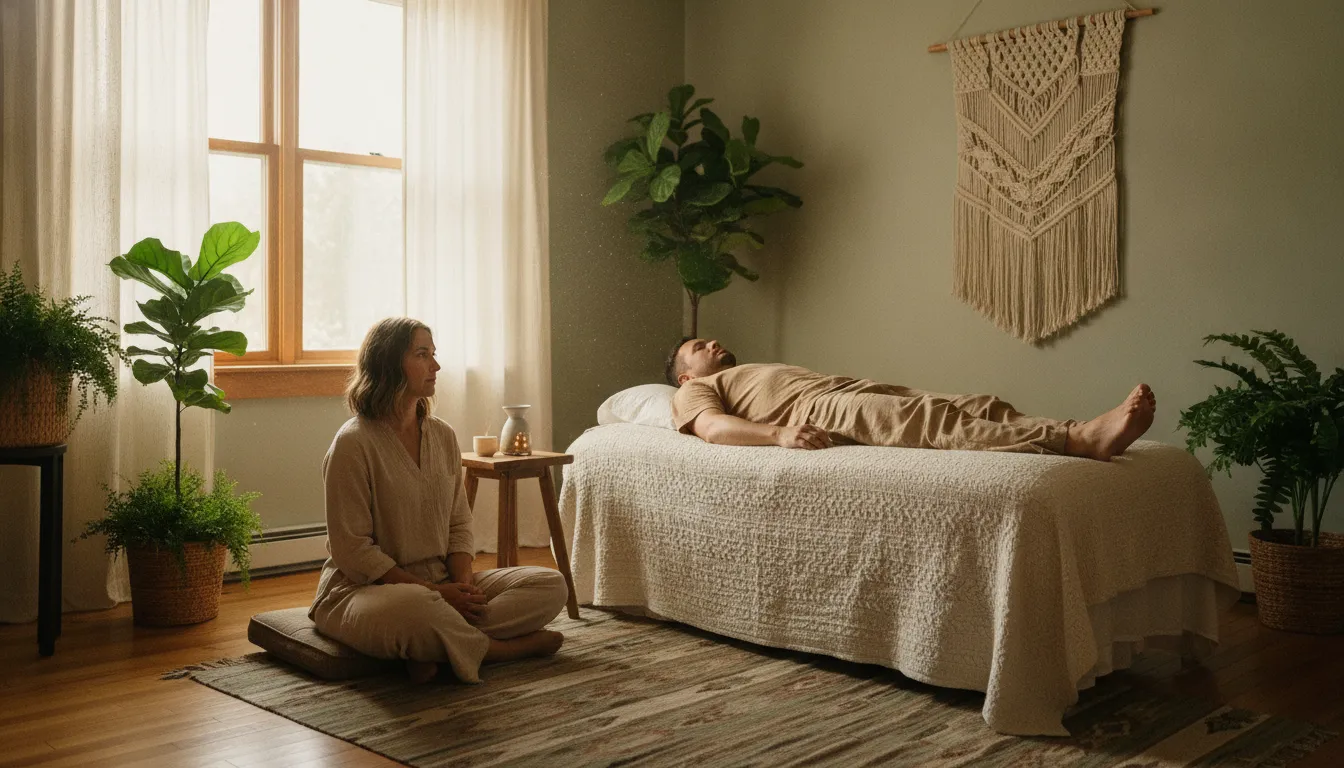
A beautiful setting can shape your experience, but it cannot answer the questions that matter most: Who is licensed to provide care? How are health risks screened? What happens if you need support before, during, or after a session?
Learn about licensed Colorado psilocybin therapy
When comparing a luxury psilocybin retreat colorado travelers may find online with a licensed Colorado natural medicine healing center, look beyond amenities. Confirm the facility's state license, facilitator qualifications, physician-reviewed screening, informed consent process, emergency planning, and preparation and integration support. Colorado regulates natural medicine services for adults 21 and older, while psilocybin remains a Schedule I substance under federal law.
The word "retreat" can describe an atmosphere or hospitality package, not a specific legal status. Understanding that distinction makes it easier to evaluate what a program actually provides, how oversight works, and whether its model fits your needs.
What Is a Psilocybin Retreat, and How Is It Regulated?
A psilocybin retreat is usually a hospitality or experience label. It may describe a private setting, comfortable accommodations, a carefully planned schedule, or additional wellness support. The word retreat does not, by itself, establish that a provider is licensed, that facilitators are authorized, or that services follow Colorado's natural medicine rules.
That distinction matters when comparing a luxury psilocybin retreat in Colorado with regulated care. Colorado's framework recognizes licensed healing centers as facilities where a state-licensed entity permits a facilitator to provide and supervise natural medicine services. The state's Department of Revenue licenses natural medicine businesses, including healing centers, while the Department of Regulatory Agencies licenses and regulates facilitators. You can review the current framework through the Colorado Department of Natural Medicine.
Regulated psilocybin services in Colorado are limited to adults who are at least 21 years old and are delivered through licensed healing centers. A provider should be able to clearly identify the healing center's license and explain how facilitator credentials, screening, consent, supervision, and emergency planning fit together. If the answer relies mainly on beautiful surroundings or broad promises, ask more specific questions.
Colorado's law is also state-level. It does not change psilocybin's federal Schedule I status, and it does not create a general federal authorization for psilocybin services. The practical result is a framework with defined boundaries, not an invitation to treat every retreat offering as regulated care. Rules can also evolve, so prospective participants should confirm details with current state resources before making a decision.
Comfort and privacy can be meaningful parts of a supportive setting. They are not substitutes for licensure or responsible practice. A refined environment should exist alongside qualified facilitators, informed consent, appropriate preparation, supervision during the natural medicine journey, and integration support. In other words, luxury can describe how a setting feels, but regulation concerns who is authorized to provide services and how those services are delivered.
For anyone evaluating options, verify the legal and clinical foundation first, then consider amenities and personal fit. That order helps separate a retreat's presentation from the safeguards that make a Colorado natural medicine service accountable.
What Does a Licensed Colorado Healing Center Offer That a Retreat Does Not?

A retreat can describe a private room, nourishing meals, beautiful surroundings, and attentive hospitality. Those elements may help someone feel comfortable, but comfort is not the same as accountable care. In Colorado, a healing center is a defined, licensed facility where a facilitator provides and supervises natural medicine services. The business and its facilitators fall under separate state licensing frameworks, creating responsibilities that a hospitality label alone does not establish.
That distinction matters when someone searches for a luxury psilocybin retreat colorado. The useful question is not whether a setting feels premium. It is whether the organization can clearly explain who is licensed, how participants are evaluated, what happens during the journey, and what support follows it.
| Area | Retreat-style offering | Licensed Colorado healing center |
|---|---|---|
| Licensure | May emphasize hospitality or a destination experience. The word "retreat" does not, by itself, confirm state licensure. | Operates as a licensed healing center, with regulated business responsibilities and licensed facilitators. Colorado defines a healing center as a facility where natural medicine services are provided and supervised. |
| Screening | Screening practices can vary by provider and may be described generally. | Entheogyn describes physician-reviewed screening that considers medical history, medications, psychiatric history, and contraindications before participation. |
| Preparation | Preparation may focus on itinerary, setting, and personal expectations. | Preparation is part of a defined therapeutic arc, with space to discuss intentions, informed consent, safety, and what to expect. |
| Journey | The experience may be presented primarily as a stay or private ceremony. | A trained facilitator supervises the natural medicine service within Colorado's regulated framework, with the setting and process designed around participant care. |
| Integration | Post-experience support may be informal, optional, or limited to the end of the stay. | Integration follows the journey as the third phase of Entheogyn's model, helping participants reflect on what they experienced and consider next steps. |
| Medical support | A retreat may offer wellness staff or on-call resources, but the scope should be confirmed directly. | Entheogyn provides a physician-supported care model. Review the details of its medical support before deciding whether the approach fits your needs. |
| Transparency | Ask which entity is licensed, who provides the service, and what support is included. | Entheogyn identifies its Golden, Colorado location, its status as a Public Benefit Corporation, and its position as a licensed, vertically integrated psilocybin healing center. Its psilocybin therapy model explains the care structure. |
A licensed model does not make promises about outcomes, and it does not remove the need for thoughtful personal evaluation. It does provide a clearer accountability structure than amenities alone can offer. For Colorado adults considering this path, ask for the license information, facilitator qualifications, screening process. Emergency plan, preparation and integration details, and a plain explanation of what is and is not included.
How Does Medical Oversight Differ Between Retreat and Clinical Settings?

The word luxury describes comfort, privacy, and personal attention. It does not, by itself, describe the quality of medical oversight. A retreat may offer a beautiful setting and a carefully planned experience. A clinical setting adds a defined process for evaluating whether psilocybin services are appropriate for a particular person.
That process should begin before a session is scheduled. At Entheogyn, prospective clients receive physician-reviewed screening that considers medical history, current medications, psychiatric history, and possible contraindications. This review is not a promise that every concern can be predicted or eliminated. It is a structured opportunity to identify relevant risks, ask questions, and determine whether the service is an appropriate fit.
Medication and psychiatric history deserve particular care. A complete review gives clinical staff a clearer picture of health conditions, prior diagnoses, past reactions, and factors that may affect the journey. It also creates space for a person to disclose information privately and without pressure. If the available information is incomplete or a concern requires further evaluation, a responsible provider should pause and clarify rather than rush toward a session.
Supervision is more than having someone present
In a regulated Colorado healing center, the setting and the people providing services operate within a state framework. Colorado distinguishes between business licensing for healing centers and facilitator licensing through the Department of Regulatory Agencies. The state definition of a healing center includes a facility where a licensed entity permits a facilitator to provide and supervise natural medicine services. That distinction matters because oversight includes more than attentive hospitality. It includes defined roles, trained supervision, preparation, consent, and a plan for responding if psychological or physiological concerns arise.
Informed consent should be an ongoing conversation, not a signature collected at the door. People deserve a balanced explanation of potential benefits, uncertainties, and risks before deciding whether to proceed. Research on psilocybin-assisted therapy emphasizes evidence-based communication and informed consent, while safety research on psilocybin administration describes psychological and physiological risks that warrant trained oversight. These sources can support a more realistic decision, but they cannot guarantee a particular outcome.
Clinical structure also has limits. Physician review cannot diagnose every future response, and trained supervision cannot promise healing, symptom resolution, or a specific emotional experience. A thoughtful physician-supported care model helps people understand those limits before they commit. For anyone comparing a luxury psilocybin retreat in Colorado with a clinical option, the most important question is not how polished the room looks. It is whether screening, consent, supervision, and follow-up are clear, documented, and appropriate for the person in front of the care team.
How Should You Evaluate a Luxury Psilocybin Retreat in Colorado?
A calm, beautiful setting can matter, but comfort is only one part of responsible care. Before choosing a provider, work through this checklist to understand what is regulated. What is included, and how the team will support you before, during, and after a session.
- Verify the facility's Colorado license. Ask whether the service is delivered in a state-licensed Healing Center, not simply at a property described as a retreat. Colorado defines a Healing Center as a licensed facility where a facilitator provides and supervises natural medicine services. You can review the state's Healing Center requirements and ask the provider for its current license information.
- Confirm facilitator credentials. The business license and the facilitator license are separate parts of Colorado's framework. Ask who will be present, whether each facilitator is licensed by the Department of Regulatory Agencies, and how their training, experience, and role relate to your care. Entheogyn also offers facilitator training and qualifications for people pursuing this work.
- Understand the medical screening process. A responsible provider should review your medical history, medications, psychiatric history, and potential contraindications before accepting you. Ask who reviews that information, what happens if the service is not appropriate, and how privacy is protected. Be wary of any process that treats screening as a formality.
- Look for a complete therapeutic arc. Ask what preparation includes, how the natural medicine journey is supervised, and whether integration support is available afterward. Clarify how many sessions are included, who provides each phase, and what follow-up may look like. A premium setting should add care and continuity, not just amenities.
- Ask for a specific emergency plan. Find out how the team responds to psychological or physiological distress, who has clinical responsibility, what emergency resources are available, and when outside medical care would be contacted. Colorado's regulated model is designed around licensed facilities and trained supervision, not around atmosphere alone.
- Review consent, privacy, and personal boundaries. You should receive clear information about potential benefits, risks, alternatives, touch policies, confidentiality, and your ability to pause or withdraw consent. Ask how concerns are documented and who you can contact after the session.
- Get transparent scope and costs. Request an itemized explanation of therapy-session pricing, preparation, integration, lodging or amenities, and any separate medicine cost. Confirm what the provider does and does not promise. No ethical provider can guarantee a particular outcome.
- Consider values and reciprocity. Ask how the organization approaches Indigenous stewardship, community benefit, accessibility, and environmental responsibility. A values statement should be reflected in policies and relationships, not presented as decorative branding.
Why Does the Legal and Regulatory Framework Matter for Your Safety?
A calm setting and thoughtful hospitality can support a meaningful experience, but they do not replace a regulated framework. In Colorado, the legal status of natural medicine services is tied to state law, licensing, and defined responsibilities. That structure gives prospective participants something concrete to verify before choosing a provider, especially when comparing a luxury psilocybin retreat in Colorado with a licensed healing center.
Colorado permits regulated psilocybin services for adults who are 21 and older through licensed healing centers. The state also separates oversight of the business from oversight of the facilitator. The Department of Revenue licenses natural medicine businesses, while the Department of Regulatory Agencies licenses and regulates facilitators. A healing center is defined as a facility where a licensed entity permits a facilitator to provide and supervise natural medicine services for a participant. Review the current state framework in this guide to Colorado natural medicine regulation. Then confirm current details through the Colorado Department of Natural Medicine.
State authorization has clear boundaries
Colorado's authorization is not the same as nationwide legal recognition. It applies within Colorado's state framework, while psilocybin remains classified as a Schedule I substance under federal law. That distinction matters when evaluating where services are offered, who may provide them, and what a provider can responsibly promise. A provider should be transparent about these boundaries rather than suggesting that a retreat or healing center operates outside them.
Rules also continue to develop. Requirements involving licensing, facilitator qualifications, premises, screening, consent, supervision. And session parameters should be checked against current state guidance instead of relying on an old article or a sales page. For example, Colorado's framework identifies licensed centers and trained facilitators as the setting for regulated services. It also sets operational limits, including a state limit on natural medicine consumption in a licensed center. Because regulations can change, ask how a provider monitors updates and communicates them to participants.
Safety is therefore more than an attractive room or a private itinerary. It includes appropriate screening, preparation, informed consent, trained supervision, clear boundaries, and an emergency plan. The legal framework does not guarantee an outcome, but it creates standards that help you ask better questions and identify whether a provider is operating within Colorado's system. Once those basics are confirmed, the next step is more personal: evaluate the relationship. Communication style, and sense of trust you build with the people responsible for your care.
Frequently Asked Questions
Are psilocybin retreats legal in Colorado?
Colorado permits regulated natural medicine services for adults 21 and older through licensed healing centers. A retreat label alone does not establish compliance. Ask whether the facility holds the appropriate state license and whether its facilitators are licensed and regulated by DORA. Colorado authorization is state-level, while federal Schedule I status remains unchanged. Review Colorado's natural medicine FAQs.
What should I expect at a luxury psilocybin retreat in Colorado?
Expect the experience to vary because luxury retreat is a hospitality description, not a standardized license. Amenities may include private rooms or a highly personalized setting, but they do not replace screening, informed consent, trained supervision, preparation, integration, or an emergency plan. Request a clear description of the full care process before choosing a provider.
How do licensed Colorado natural medicine healing centers operate?
A licensed healing center is a state-authorized facility where a facilitator provides and supervises natural medicine services. Colorado separates business licensing from facilitator regulation: the Department of Revenue licenses natural medicine businesses, while DORA licenses and regulates facilitators. Ask how the center handles screening, preparation, the journey, integration, documentation, and participant consent. See the state's healing center requirements.
What is the difference between a retreat center and a licensed healing center?
A retreat center may emphasize comfort, privacy, and wellness hospitality, but the word retreat does not by itself confirm state licensure. A licensed healing center operates within Colorado's natural medicine framework and has state-regulated facilitators. The strongest option can offer a warm, elevated setting while making its license, clinical boundaries, safety procedures, and participant rights easy to verify.
How can I evaluate a psilocybin retreat provider?
Start by verifying the facility's Colorado license and each facilitator's DORA license. Then ask about medical and psychiatric screening, medication review, preparation and integration support, consent practices, supervision, emergency planning, and what the fee includes. Look for specific answers rather than relying on luxury imagery, testimonials, or promises of a particular outcome.
Schedule a Connection Call About Your Colorado Care Options
Questions about regulation, medical oversight, or what to look for in a healing setting deserve a thoughtful conversation. Entheogyn can help you explore whether its licensed Colorado psilocybin therapy model fits your questions and goals, with space to discuss your needs before deciding on next steps.