
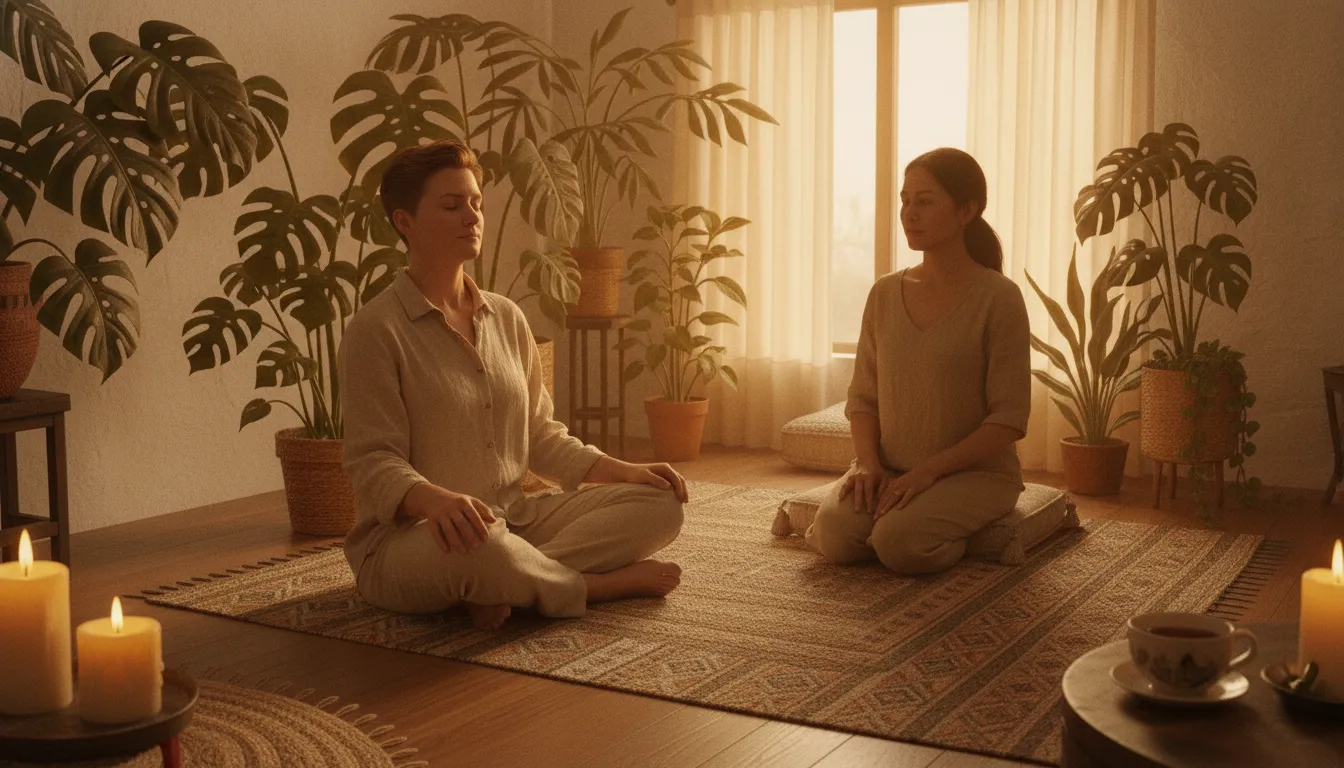
Colorado's natural medicine framework has created a defined professional path for people who want to support psilocybin sessions with care, preparation, and accountability. This is not a shortcut into clinical practice. It is a regulated field that calls for specialized education, supervised experience, and a clear understanding of Colorado's responsibilities for facilitators.
Psilocybin facilitator training colorado programs should prepare you for the state's licensing pathway through approved education, practicum and consultation hours, ethical practice, and trauma-informed care. DORA oversees facilitator licensure, so choosing training aligned with those requirements is an essential first step.
For aspiring facilitators, the right program connects the science of psilocybin with the lived realities of holding a safe, respectful setting. It also honors the traditional lineages of natural medicine while preparing practitioners for the standards of a modern healing center. Here is how that licensed pathway takes shape.
Explore the psilocybin facilitator training program to see how a DORA-aligned, vertically integrated pathway can support your next step.
Psilocybin Facilitator Training in Colorado: A Licensed Pathway to Healing
Working as a psilocybin facilitator in Colorado involves more than personal experience with natural medicine or a desire to support meaningful change. It is a regulated professional pathway that combines specialized education, supervised practice, ethical responsibility, and an understanding of Colorado's natural medicine framework. The Colorado Department of Regulatory Agencies (DORA) oversees professional licensure, making state alignment an essential consideration when you compare training programs. DORA's regulatory guidance should be part of your research from the beginning.
Colorado requires specialized training for individuals seeking licensure as psilocybin facilitators. One academic program, for example, describes more than 150 hours of interdisciplinary education as the first step toward a Colorado training license. Program requirements can vary by provider, so prospective facilitators should confirm that a curriculum is approved for the credential they intend to pursue rather than assuming that any certificate leads to licensure.
What the pathway asks of a facilitator
A strong training pathway develops both professional competence and a grounded relationship with the medicine. Didactic learning may address the traditional roots of natural medicine, the science of psilocybin, trauma-informed care, set and setting, harm reduction, ethics, and Colorado-specific responsibilities. The goal is not to prescribe a universal experience. It is to prepare a facilitator to create conditions for safety, consent, presence, and careful discernment while respecting that the medicine is the teacher.
Training also needs to move beyond the classroom. Colorado's certification pathway includes practicum and consultation components, giving learners opportunities to translate principles into responsible practice with appropriate supervision. For career-changing professionals, that applied work can clarify whether facilitation fits their temperament and professional commitments. For healing-center operators, it offers a way to evaluate how training, client care, documentation, and compliance must work together in a real setting.
From education to responsible practice
The most useful program is one that makes the full arc visible: regulatory requirements, scientific literacy, relational skill, practical safety, and ongoing accountability. Entheogyn's 230-hour facilitator training program was developed in alignment with Colorado DORA guidelines and includes hands-on experience and regulatory compliance education. Its vertically integrated setting also connects training with the broader realities of cultivation, medicine production, dosing, and clinical administration.
Whether you are entering from mental health care, coaching, spiritual practice, or another profession, begin by reviewing the credential, practicum, and oversight details in writing. Then explore Entheogyn's psilocybin facilitator training program to understand how a Colorado-centered education can support a careful, service-oriented career in natural medicine.
Why Colorado Became the Center of Natural Medicine Facilitation
Colorado's position in natural medicine facilitation began with a deliberate change in state law. The Natural Medicine Health Act, established through Proposition 122, created a state-regulated framework for psilocybin services and related natural medicine activity. Rather than treating facilitation as an unregulated private practice, the framework places safety, accountability, and professional preparation at the center of access.
This development should also be understood in its proper historical context. Psilocybin is not a modern Western discovery. Indigenous peoples and traditional cultures have stewarded relationships with fungi and other natural medicines across generations, carrying knowledge about ceremony, community, responsibility, and reciprocity. Colorado's regulatory system exists within that larger history. A responsible professional pathway acknowledges those lineages instead of presenting current legislation as the beginning of the story.
What Proposition 122 changed
Proposition 122 established a legal foundation for adults to engage with natural medicine in a supervised, regulated setting in Colorado. The model is Colorado-specific. It does not make psilocybin services broadly available across the United States, and it does not mean that every person or organization may provide facilitation. Eligibility, licensing, location, supervision, and operating requirements remain governed by state rules.
The state describes psilocybin as a natural medicine under the Natural Medicine Health Act. That terminology matters because it reflects a regulatory model built around trained facilitation and controlled access, not casual or commercial distribution. The framework is intended to support safe and ethical practice through certified natural medicine facilitator training, as outlined in Colorado's natural medicine guidance.
Why DORA oversight matters
The Colorado Department of Regulatory Agencies, commonly called DORA, oversees licensure for psilocybin facilitators and plays a central role in the professional pathway. DORA's regulatory resources are therefore essential for anyone evaluating a training program or planning a career in Colorado natural medicine facilitation.
For prospective facilitators, oversight creates a practical standard: training is not simply about personal experience or interest in psilocybin. It requires preparation for ethical responsibilities, participant safety, and the realities of working within Colorado law. Certified training programs are designed to support that standard, with education that can include natural medicine history, trauma-informed care, harm reduction, and supervised practice. The result is a framework that asks facilitators to pair reverence for the medicine and its lineages with disciplined, accountable professional conduct.
What Colorado Psilocybin Facilitator Certification Requires
Colorado's pathway to licensed psilocybin facilitation combines baseline eligibility, emergency-care preparation, formal education, supervised practice, and review by the state's regulatory system. The exact rules and application materials can change, so prospective facilitators should confirm current requirements with the Colorado Department of Regulatory Agencies (DORA). The following sequence provides a practical overview of what to expect.
- Confirm that you meet the basic eligibility requirements. Applicants must be at least 21 years old. Colorado's model also requires a background check, which means applicants should be prepared to disclose the information requested during the licensing process and address any questions before enrolling. Starting with eligibility can prevent an avoidable investment in a program that does not fit your circumstances.
- Obtain Basic Life Support certification. Basic Life Support, or BLS, gives facilitators foundational training for responding to an emergency while maintaining a calm, safety-centered environment. It is a practical complement to the relational and reflective skills involved in sitting with someone through a natural medicine experience. Keep documentation of your current certification and check whether the state or a training provider specifies an approved course or renewal interval.
- Complete an approved didactic facilitator training program. Specialized education is required for people seeking Colorado psilocybin facilitator licensure. Programs may cover natural medicine traditions, ethics, legal responsibilities, preparation, facilitation, integration, trauma-informed care, and harm reduction. For example, Naropa describes more than 150 hours of interdisciplinary education as part of the first step toward Colorado licensure: its facilitator training certificate program. Confirm that a program's approval and curriculum align with current DORA expectations before enrolling.
- Complete the in-person practicum. Didactic study cannot replace supervised, in-person skill development. Colorado-oriented training pathways commonly include a practicum of approximately 40 hours, where learners build competency through observation, participation, feedback, and structured reflection. This portion helps translate concepts such as set and setting, communication, consent, and safety planning into responsible practice.
- Fulfill consultation and supervised work hours. Consultation hours are an essential part of certification, not an optional add-on. They give trainees a structured way to review their work, identify safety or ethical concerns, and deepen judgment with experienced oversight. The required combination of practicum and consultation hours is reflected in facilitator training guidance from the University of Colorado Denver: its education and training resources. Track attendance, supervision, and completion records carefully.
- Apply through the current Colorado licensing process. After completing the required training, BLS, background check, practicum, and consultation components, assemble the documentation requested for licensure and submit it through the applicable state process. DORA oversees professional licensure in Colorado, so use its current guidance rather than relying on an older program page or informal checklist: visit DORA for regulatory information. Licensure is the point at which training becomes permission to practice within Colorado's regulated natural medicine framework.
This sequence is demanding by design. A strong program should prepare you not only to satisfy a checklist, but also to hold safety, humility, cultural respect, and clear professional boundaries throughout the work.
What a DORA-Aligned Training Curriculum Covers
A strong facilitator curriculum brings scientific understanding, relational skill, ethical responsibility, and supervised practice into the same learning path. The goal is not simply to memorize information about psilocybin. It is to develop the discernment required to hold a safe, respectful setting while another person engages with the medicine.
Psychedelic science and the medicine's foundations
Training begins with a grounded study of psilocybin, including its molecular foundations, effects, potential risks, and practical applications in a regulated setting. Psilocybin is a naturally occurring compound found in more than 200 species of fungi, with traditions of relationship and stewardship held by cultures around the world. A responsible program should place current science alongside that history, rather than presenting the medicine as a modern Western discovery.
Students also learn how preparation, set and setting, dose-related considerations, environment, and individual circumstances can shape an experience. This scientific foundation supports careful decision-making without reducing a deeply personal process to a purely clinical formula. University of Colorado Denver's training overview identifies molecular foundations and practical applications as core parts of facilitator education.
Facilitation, safety, and ethical practice
Facilitation skills involve much more than directing a session. Trainees practice attentive presence, clear communication, boundaries, consent, nonjudgmental support, and responses to changing needs. They learn how to prepare participants, maintain an appropriate container, recognize when additional support may be needed, and understand their responsibilities within Colorado's regulated natural medicine framework.
Safety and ethics are inseparable from this work. Training should address confidentiality, scope of practice, professional conduct, cultural humility, and the power dynamics that can arise when someone is vulnerable. The Colorado Department of Regulatory Agencies oversees licensure, making regulatory literacy an essential part of a DORA-aligned program. DORA is the appropriate source for current regulatory information.
Trauma-informed care, harm reduction, and integration
Trauma-informed care helps facilitators avoid assumptions and create conditions that support choice, dignity, and psychological safety. Coursework commonly includes set and setting, screening and preparation, contraindication awareness, harm reduction, and ways to respond when an experience becomes difficult. The emphasis is not on promising a particular outcome. It is on reducing avoidable risk and meeting each participant with care.
Integration extends that responsibility beyond the session itself. Psychedelic Harm Reduction and Integration coursework addresses how participants can make meaning of what arose, identify practical next steps, and seek appropriate support when needed. These skills help facilitators remain present to the whole arc of the work rather than treating the session as an isolated event. CU Denver's curriculum description lists Psychedelic Harm Reduction and Integration as a key training module.
Practicum and consultation
Didactic study needs to be tested through supervised experience. A complete pathway includes practicum hours, feedback, reflection, and consultation with qualified educators or peers. These components allow trainees to translate concepts into careful action while receiving guidance before practicing independently. Practicum and consultation hours are identified as essential elements of natural medicine facilitator certification. And the exact requirements should always be confirmed against current Colorado rules and the approved program's curriculum.
Why Training at a Vertically Integrated Center Stands Apart
In Colorado's emerging natural medicine framework, facilitator training is not only a classroom exercise. It is preparation for a professional responsibility that connects the medicine, the setting, the participant, and the regulations governing care. Entheogyn offers that preparation within Colorado's first licensed, vertically integrated psilocybin healing center in Golden, where cultivation, manufacturing, clinical administration, and facilitator education operate within one organization.
See the full path from medicine to session
At many training programs, students learn about psilocybin medicine through lectures, case studies, and supervised practicum. Those elements matter, but an integrated center can make the relationship between them more tangible. Students can learn how medicine is produced and prepared, how dosing decisions are approached, and how clinical administration is carried out in a regulated setting. The result is a more connected view of the facilitator's work, from the integrity of the medicine to the care provided in the session room.
This perspective also helps students understand that facilitation is not isolated from operations. A safe and ethical session depends on careful preparation, consistent processes, appropriate documentation, and respect for the boundaries of Colorado's Natural Medicine Health Act. Hands-on experience gives learners an opportunity to connect those principles to the realities of practice, rather than treating compliance as a separate subject to memorize.
A 230-hour program grounded in Colorado requirements
Entheogyn's 230-hour facilitator training program is developed in alignment with Colorado Department of Regulatory Agencies guidelines for Natural Medicine Facilitators. The curriculum combines education in natural medicine, practical facilitation skills, hands-on learning, and regulatory compliance. That combination is designed for people who want to understand both the human and operational dimensions of this work. Including mental health professionals, healthcare practitioners, coaches, and spiritual practitioners.
Training at a working healing center can also clarify the standards expected in a professional environment. Students encounter the importance of preparation, informed participation, ethical boundaries, and a consistent care setting. These are not promises of a particular therapeutic outcome. They are foundations for responsible practice within a regulated Colorado pathway.
Sacred responsibility, scientific discipline
Entheogyn's model reflects its position as a Public Benefit Corporation. Scientific discipline and clinical accountability are paired with indigenous reciprocity and respect for the origins and lineages of psilocybin medicine. The medicine is approached with care and humility, while production and administration are supported by structured processes and quality-focused oversight.
For students comparing programs, this integrated context can be a meaningful distinction. Explore Entheogyn's psilocybin facilitator training program to learn how the 230-hour curriculum, hands-on experience, and DORA-aligned approach may fit your professional path.
How Licensed Healing Centers Source Psilocybin Medicine
Licensed healing centers need more than access to psilocybin medicine. They need a supply process that supports quality, regulatory compliance, consistent preparation, and clear communication during clinical sessions and research. Colorado's natural medicine framework makes the relationship between a healing center and its supplier especially important. Every organization should be able to explain where its medicine comes from, how it is tested, and how dosing information is documented.
There are two common approaches. A healing center may work with a vertically integrated producer that manages cultivation, manufacturing, testing, and related compliance in one connected system. Alternatively, it may source medicine from multiple third-party vendors. Both models can be evaluated carefully, but they create different operational responsibilities.
| Consideration | Vertically integrated producer | Third-party sourcing |
|---|---|---|
| Quality | Cultivation, manufacturing, and lab testing are coordinated within one system, creating clearer oversight from origin to finished medicine. | Quality information must be gathered and compared across vendors, batches, and documentation systems. |
| Compliance | Compliance procedures can be designed around one documented chain of custody and the center's operational needs. | The healing center must verify each supplier's licensing, records, testing, and ongoing compliance independently. |
| Consistency | Integrated production can support more consistent cultivation standards, batch records, and communication about available medicine. | Differences between vendors may create variation in records, availability, preparation, and product specifications. |
| Dosing support | The producer can connect cultivation and laboratory information with practical dosing and clinical-administration education. | Dosing information may require coordination among the healing center, supplier, laboratory, and facilitator team. |
Why the supply relationship matters
Vertical integration does not replace professional judgment or the center's responsibility to follow Colorado requirements. It can, however, give facilitators and clinical administrators a more complete view of the medicine they are preparing to work with. That context supports careful planning, transparent records, and respectful engagement with natural medicine.
Entheogyn is vertically integrated in Golden, providing high-quality, lab-tested psilocybin medicine for clinical sessions and research. Its B2B medicine pricing is $4.50 per milligram of psilocin. Healing centers can also review the organization's cultivated psilocybin strains as part of a broader conversation about sourcing, testing, and consistency.
Choosing an Approved Psilocybin Facilitator Training Program
Colorado's training landscape includes university-based education, clinical-network programs, and training connected to operating healing centers. The best fit depends on your intended role, learning style, and the depth of supervised practice you need. Before comparing tuition or delivery format. Confirm that the program supports the state pathway and that its curriculum prepares you for the responsibilities of working with natural medicine in Colorado.
Compare the learning model
University programs can offer academic breadth and a strong foundation in research, ethics, and facilitation. Naropa University's Psilocybin Facilitator Training Certificate Program is designed for legal adult-use psilocybin facilitation under state regulatory models and describes more than 150 hours of interdisciplinary education toward a Colorado Training License. Read the program details from Naropa University.
The University of Colorado Denver takes a flexible approach, combining weekly self-paced online modules with scheduled virtual classroom meetings two evenings each week. That format may suit people balancing employment or family responsibilities, while still providing structured interaction with educators. Its curriculum addresses psychedelic science and facilitation, including molecular foundations, practical applications, and practicum and consultation hours. Review CU Denver's education and training model.
Clinical and network providers offer another route. Numinus provides a DORA-approved pathway that includes a 40-hour practicum, while Synthesis describes a core training of more than 150 hours and a Colorado-specific training module. These programs may appeal to learners who want a clear connection to clinical operations, professional networks, or a structured transition from coursework into practice.
Look beyond the program label
An approved program should make its relationship to Colorado's Department of Regulatory Agencies clear. DORA oversees facilitator licensure, so ask exactly what approval covers, which license stage the training supports, and whether requirements can change before you complete the pathway. Approval alone is not a substitute for a rigorous education.
Look for breadth across trauma-informed care, harm reduction, ethics, cultural and traditional roots, set and setting, science, and integration. Confirm the number and format of practicum and consultation hours, who supervises them, and how feedback is documented. Experiential learning should be held with clear boundaries, not presented as a shortcut to competence.
Finally, consider whether the program is connected to a vertically integrated clinical center. Learning alongside cultivation, dosing, clinical administration, and laboratory-tested medicine can make regulation and accountability more tangible. Entheogyn's psilocybin facilitator training program is designed around that integrated context in Golden. Compare each option carefully, then choose the setting that supports both disciplined practice and reverence for the medicine.
Talk to our team about facilitator training in Colorado and whether the 230-hour, DORA-aligned program fits your goals.
Frequently Asked Questions
What are the requirements to become a licensed psilocybin facilitator in Colorado?
Applicants generally need to be at least 21, complete an approved training pathway, obtain required safety certifications, pass a background check, and complete supervised practicum and consultation requirements. Colorado's Department of Regulatory Agencies (DORA) oversees facilitator licensure, so requirements and approved pathways should be confirmed through current state guidance.
How long does psilocybin facilitator training take?
The timeline depends on the program format and the license stage you are pursuing. Colorado pathways may combine roughly 150 hours of didactic education with practicum and consultation, while some programs use an 18-week schedule. Entheogyn's DORA-aligned facilitator training program includes 230 hours of instruction and hands-on learning.
Does Colorado require a practicum for psilocybin facilitator certification?
Yes. Practicum experience is a core part of the pathway because reading and classroom work cannot replace supervised practice. Program requirements commonly include a 40-hour practicum in addition to didactic education, along with consultation hours. Confirm the current requirements with DORA and the specific approved program.
What does the Natural Medicine Health Act mean for psilocybin facilitators?
The Natural Medicine Health Act, often called Prop 122, establishes Colorado's regulatory framework for natural medicine services, including psilocybin. Facilitators must work within state rules for training, licensing, safety, ethics, and service delivery. It does not make psilocybin a general medical cure or authorize services outside Colorado.
Do I need prior clinical experience to enter facilitator training?
Not every applicant comes from the same professional background. Mental health professionals, healthcare practitioners, coaches, and spiritual practitioners may each bring relevant experience, but eligibility depends on the approved program and state licensing requirements. Look for training that develops trauma-informed care, harm reduction, ethics, practical facilitation, and Colorado-specific responsibilities.
Ready to Start Your Colorado Training Journey?
Choosing a facilitator training path is an important step toward serving natural medicine work with care, preparation, and respect. Entheogyn can help you explore the training pathway and determine whether its program fits your goals. Contact us about the psilocybin facilitator training program to begin the conversation with our team.