
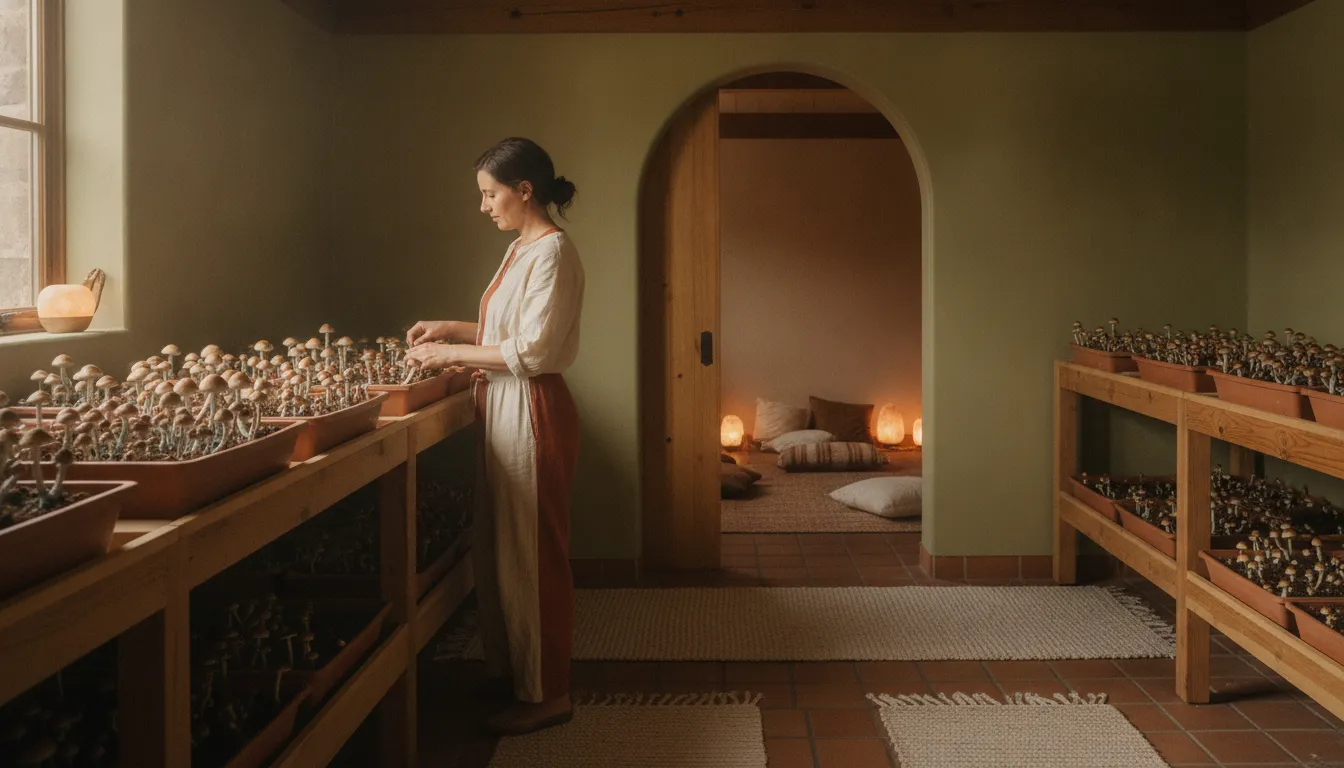
When people hear "from spore to ceremony," they may picture a simple supply chain. In Colorado, responsible natural medicine care is more deliberate: cultivation, processing, testing, screening, supervised support, and integration each carry their own responsibilities.
Vertically integrated psilocybin natural medicine means connecting those stages within one accountable ecosystem, so the path from cultivation through care can be understood and carefully stewarded. At Entheogyn, that model includes licensed cultivation, independently tested medicine, physician-reviewed preparation, a supervised journey, and participant-led integration. It does not guarantee a particular outcome, and Colorado regulation does not change psilocybin's federal Schedule I status. For the state framework, see our guide to Colorado natural medicine regulations.
This distinction matters because vertical integration is more than a label. It describes how quality, consent, safety, education, and ethical responsibility connect across the full arc of care. Understanding that structure starts with what the term actually means.
How Vertically Integrated Psilocybin Natural Medicine Connects Care
Vertical integration describes a connected chain of responsibility. In natural medicine care, that chain can begin with cultivation and processing, continue through quality review and clinical preparation, and extend into supervised care, education, and stewardship. Each stage remains connected to the next, so the people responsible for care can speak more clearly about where the medicine came from. How it was prepared, and what support surrounds the participant.
For Entheogyn, the model is described as a Colorado licensed, vertically integrated psilocybin healing center. Its stated ecosystem spans cultivation, medically supported care, and facilitator training. With quality control "from spore to ceremony." These are company-specific statements about its structure, not universal requirements for every natural medicine provider. Learn more about Entheogyn's vertically integrated ecosystem.
What vertical integration does not mean
The phrase is not a clinical credential, a substitute for licensing, or a promise that every participant will have the same experience. It also does not mean that one organization can disregard the separate responsibilities attached to cultivation, testing, clinical care, or facilitator education. Accountability still depends on appropriate oversight at each stage.
It is also different from a marketing label that simply places several services under one brand. A meaningful model should make the relationships between those services understandable. Readers should be able to ask who cultivates the medicine, who reviews its quality. Who evaluates a prospective participant, who provides support during a journey, and what happens afterward. Clear answers create a traceable chain rather than an abstract claim.
The care side matters as much as the supply side. Entheogyn describes a pathway that includes a medical intake reviewed by an on-site physician, preparation before a journey, and integration afterward. Integration leaves room for the participant's own meaning-making, with facilitator support rather than a fixed interpretation. This keeps agency at the center of the relationship. Explore the preparation, journey, and integration process.
| Stage | Accountability question |
|---|---|
| Cultivation | Where and under what license was the medicine grown? |
| Testing and preparation | How was quality reviewed and the medicine prepared? |
| Care | Who screens, supports, and follows up with the participant? |
Stewardship adds another boundary. Entheogyn identifies as a Public Benefit Corporation and says its structure prioritizes purpose over profit. That governance choice does not establish a clinical outcome, yet it explains how the organization frames responsibility beyond a single appointment. In that sense, vertically integrated psilocybin natural medicine is best understood as a traceable, accountable connection between origin, care, learning, and purpose.
Why Does Cultivation-to-Ceremony Integration Matter for Medicine Quality?
Medicine quality begins before a ceremony. When cultivation, preparation, testing, and care are connected, each stage can be understood as part of one accountable chain rather than as an isolated transaction. That connection supports traceability: a healing center can ask where the medicine came from, who prepared it, and whether independent testing was part of the process.
Entheogyn describes its model as quality control "from spore to ceremony," linking cultivation with medically supported care and facilitator training. This does not mean that one organization can guarantee a particular experience or outcome. It means the path from cultivation to ceremony is visible enough to invite careful questions and responsible oversight.
Traceability starts with a known source
According to Entheogyn, every strain offered is grown in its own licensed laboratory. The company states that it cultivates eleven distinct psilocybin strains and provides three prepared forms. These are company-specific statements, not universal standards for natural medicine or a promise that one strain or form will create a particular effect. Their value is that they make the origin and presentation of the medicine part of the conversation.
In a vertically integrated psilocybin natural medicine model, that conversation can extend across the full care pathway. Cultivation decisions matter because medicine is later brought into a setting shaped by preparation, consent, facilitation, and integration. Keeping those relationships visible helps clients and licensed healing centers ask more precise questions about sourcing and accountability.
Independent testing adds another point of review
Entheogyn states that every batch is cultivated in-house and independently tested by Nordic Analytical Laboratories in accordance with DORA regulations. Independent review does not remove the need for screening, professional care, or honest communication about uncertainty. It provides an additional quality checkpoint and helps separate a documented sourcing claim from a vague promise of purity or safety.
For licensed healing centers seeking tested psilocybin medicine for licensed healing centers, the practical question is not simply whether medicine is natural. It is whether its path can be explained clearly, whether testing claims are attributable, and whether the supply relationship respects the responsibilities of the ceremony. Entheogyn's public benefit corporation structure also frames its work around purpose over profit, according to the company.
This approach treats quality as more than a laboratory checkpoint. It connects responsible cultivation with transparent sourcing and respectful care, while leaving room for client agency and the limits of what testing can establish.
How Does Vertical Integration Improve Safety and Consistency?
Vertical integration can make a care pathway more accountable because important decisions remain connected across cultivation, clinical screening, preparation, the supervised journey, and integration. It does not make psilocybin care risk-free, and it cannot promise a particular emotional, physical, or therapeutic outcome. Its value is in making each handoff visible, documented, and subject to appropriate oversight.
At Entheogyn, the process begins with a thorough medical intake reviewed by an on-site physician before medicine is administered. That review can include medical and psychiatric history, current medications, family history, contraindications, and potential interactions. The academic literature explains why those controls matter. Psilocybin therapy involves medical complexity and vulnerable patients. Responsible clinical practice must account for monitoring, contraindications, adverse events, and drug interactions (peer-reviewed clinical safety review). A screening process is a decision point, not a guarantee that every risk can be predicted or removed.
Preparation adds another layer of consistency without treating participants as interchangeable. Entheogyn holds preparation sessions in the days or weeks before a journey, creating space to discuss expectations, consent, boundaries, support needs, and questions about the setting. The aim is not to script what someone should feel. It is to help each participant arrive with a clearer understanding of the process and the freedom to communicate throughout it.
During the supervised journey, the setting itself becomes part of the safety plan. A thoughtfully designed environment, attentive facilitation, and respect for participant choice can support a calm, non-directive experience. Research has linked consideration of setting and dosage, along with excluding people with psychotic predispositions in studied contexts, with a high degree of safety. The same review also stresses the need for a more nuanced understanding of individual reactions (systematic review of acute reactions). Some psychological states, including apprehension, preoccupation, or confusion, have been associated with more acute adverse reactions. That finding supports careful screening and preparation, not a claim that preparation controls the outcome.
Finally, integration keeps care from ending when the supervised session ends. Participants can reflect on their own experience, identify meaning in their own words, and decide what support they want afterward. Facilitators can provide ongoing integration sessions when a participant chooses to continue the relationship, while preserving participant agency rather than imposing an interpretation. Learn more about psilocybin therapy services and preparation and integration support.
How Colorado's Regulatory Framework Shapes the Supply Chain
Colorado's Natural Medicine Health Act created a state-level framework for regulated psilocybin and psilocin services. Within that framework, eligible adults must be 21 or older, and services are provided through licensed Colorado operations rather than an informal or unregulated market. This state authorization does not change psilocybin's federal Schedule I status, nor does it establish national availability.
For readers evaluating Colorado natural medicine regulations, the central point is that legality depends on a defined state system. Proposition 122, approved in November 2022, established the foundation. Senate Bill 23-290 then supplied important implementation details in 2023. Rules and agency guidance remain the right reference points for current requirements, including information from Colorado's Natural Medicine Division and the state's professional licensing resources.
One connected model, several regulated responsibilities
A vertically integrated psilocybin natural medicine model can connect cultivation, processing, testing, clinical delivery, and facilitator education. Integration creates a clearer chain of accountability, but it does not erase the separate duties attached to each activity. Cultivation must remain within the applicable state requirements. Manufacturing and testing have their own oversight. Healing centers must operate within the rules governing licensed service settings. Facilitators and training programs also remain subject to professional standards.
Colorado assigns oversight across state agencies. The Department of Revenue regulates healing centers, cultivation, manufacturing, and testing facilities. The Department of Regulatory Agencies, including its professional licensing functions, regulates facilitators and training. That division matters as a company may coordinate these functions while still meeting the requirements attached to each license and role.
Entheogyn describes its own Colorado model as extending from cultivation and medicine processing through medically supported care and facilitator education. Its public materials also state that each batch is cultivated on site and independently tested by Nordic Analytical Laboratories in accordance with DORA regulations. These are company-specific statements, not a guarantee that every operator follows the same structure or that any participant will experience a particular result.
For clients, the practical question is not whether the phrase "vertically integrated" sounds comprehensive. Ask which licensed entities perform each responsibility, how testing and records are handled, who oversees the healing-center experience, and how facilitator qualifications are maintained. A transparent supply chain should make those boundaries understandable while preserving participant consent, agency, and access to appropriate information.
What Should Clients Ask About Medicine Sourcing at a Healing Center?
- Where does the medicine originate? Ask whether cultivation happens within the center's licensed operation or through an outside supplier. Entheogyn describes an in-house cultivation model and quality control from spore to ceremony. Its public materials state that every batch is cultivated in-house and independently tested by Nordic Analytical Laboratories in accordance with DORA regulations. Read the center's sourcing and care details.
- What testing takes place before a client receives it? Ask which independent laboratory performs the testing, what regulations govern the process, and how batch identity is maintained from cultivation through preparation. A clear answer should distinguish documented testing from a broad promise that an experience will be safe or predictable.
- How is the medicine prepared for the session? Ask what forms are offered, how preparation is documented, and who determines the appropriate session plan. Entheogyn states that its laboratory cultivates eleven psilocybin strains and prepares medicine in three forms. Those details describe the available care model, not a promise that one form or strain will produce a particular result.
- Who reviews my medical history? Ask whether a physician reviews medications, psychiatric history, family history, contraindications, and possible interactions before the journey. Entheogyn says every prospective client receives a thorough medical intake reviewed by an on-site physician before medicine is administered. Screening supports informed decisions, but it is not a guarantee that every risk can be predicted.
- What is the facilitator's role? Ask how facilitators support consent, participant agency, and a non-directive setting. Clarify who remains present, how boundaries are handled, and how concerns are escalated. Facilitation should create room for the participant's experience rather than impose an interpretation.
- How are set and setting addressed? Ask what preparation happens before the journey, how the physical environment is designed, and how participants can communicate their needs. Research emphasizes that setting, dosage, contraindication screening, and individual differences all matter in studied contexts. A thoughtful center should explain these factors plainly.
- What happens after the journey? Ask whether integration is available, how soon follow-up can occur, and whether the participant remains free to decide what the experience means. Entheogyn describes a three-phase arc of preparation, journey, and integration, with ongoing integration sessions available when a participant chooses to continue the relationship.
- Who is eligible, and what is the legal scope? Ask whether services are provided through a licensed Colorado healing center and confirm the age requirement. Colorado-regulated natural medicine services are for adults twenty-one and older. State regulation does not change psilocybin's federal Schedule I status, so a responsible center should explain both boundaries.
- How does the center practice ethical stewardship? Ask how its business structure, sourcing relationships, education, and community commitments reflect reciprocity and respect for Indigenous knowledge. Entheogyn identifies as a Public Benefit Corporation that prioritizes purpose over profit. Look for specific commitments, not only values language.
A More Accountable Way to Understand Natural Medicine Care
A vertically integrated model matters because it makes relationships across the care pathway visible. Cultivation, independent testing, clinical support, education, and post-journey integration are not isolated promises. They are connected responsibilities. When one organization coordinates those responsibilities, participants and professional partners can ask clearer questions about where the medicine comes from. How quality is reviewed, who provides care, and how concerns are addressed.
That coordination still has limits. Integration does not guarantee a particular experience, medical outcome, or emotional result. Psilocybin care is not appropriate for everyone, and screening, consent, preparation, supervision, and participant agency remain essential. A responsible healing center creates conditions for informed participation without claiming control over what a person will feel or understand.
Accountability includes the people behind the care
For facilitators, accountability means more than completing a credential. It includes learning how to support a participant without imposing an interpretation, recognize the boundaries of a role, and remain attentive to preparation and integration. Entheogyn describes its facilitator education as a 230-hour curriculum for aspiring licensed psilocybin facilitators. Readers exploring that professional path can learn more about Colorado facilitator training.
For licensed healing centers, accountable sourcing and care also create a foundation for trust with participants and professional partners. The model should honor Indigenous knowledge and living traditions rather than presenting natural medicine as a new Western discovery. Reciprocity requires more than respectful language. It calls for ongoing reflection about extraction, benefit, responsibility, and the communities connected to this field.
Entheogyn identifies as a Public Benefit Corporation, describing a structure that prioritizes purpose over profit. Its ethical stewardship commitments offer a place to examine how public benefit, education, sourcing, and operational decisions fit together. This is the practical promise of an accountable model: clearer provenance, more deliberate care, stronger professional standards, and a willingness to name what remains uncertain.
Explore a grounded Colorado care pathwayFrequently Asked Questions
What does vertically integrated psilocybin natural medicine mean?
It describes a connected care and supply chain, from cultivation through preparation, ceremony, and integration. Entheogyn describes its model as spanning cultivation, medically supported care, and facilitator training, with quality control from spore to ceremony. Entheogyn
How can a client ask about psilocybin sourcing?
Ask where the medicine was cultivated, whether each batch receives independent testing, and how the healing center documents its supply chain. Entheogyn states that every batch is cultivated in-house and independently tested by Nordic Analytical Laboratories in accordance with DORA regulations. Entheogyn psilocybin therapy information
What safety steps belong in a Colorado psilocybin care pathway?
A responsible pathway can include medical intake, physician review, preparation before the journey, supervised care, and integration afterward. Entheogyn states that prospective clients receive medical review before medicine is administered, followed by preparation and integration options. Screening and oversight support safety, but no process guarantees an outcome. A peer-reviewed review
Is psilocybin care legal in Colorado?
Entheogyn describes its services as part of a licensed therapeutic practice in Colorado, for adults age 21 and older. Colorado state authorization does not change psilocybin's federal Schedule I status, so eligibility and setting matter. Read the current Colorado natural medicine regulations before seeking care.
What is the difference between natural and synthetic psilocybin?
Natural psilocybin refers to psilocybin sourced from cultivated fungi, while synthetic psilocybin refers to a compound produced through laboratory chemistry. A natural origin alone does not establish safety or a guaranteed result. Quality, screening, preparation, supervision, and integration remain important parts of accountable care.
Get started with Colorado psilocybin therapy
Understanding cultivation, oversight, and care can help you ask thoughtful questions about your next step. Entheogyn offers a grounded place to learn about Colorado psilocybin therapy services and whether they align with what you are seeking. Reach out to learn more and request a connection call about the care pathway, preparation, and support available.
Request a connection call about Colorado psilocybin therapy